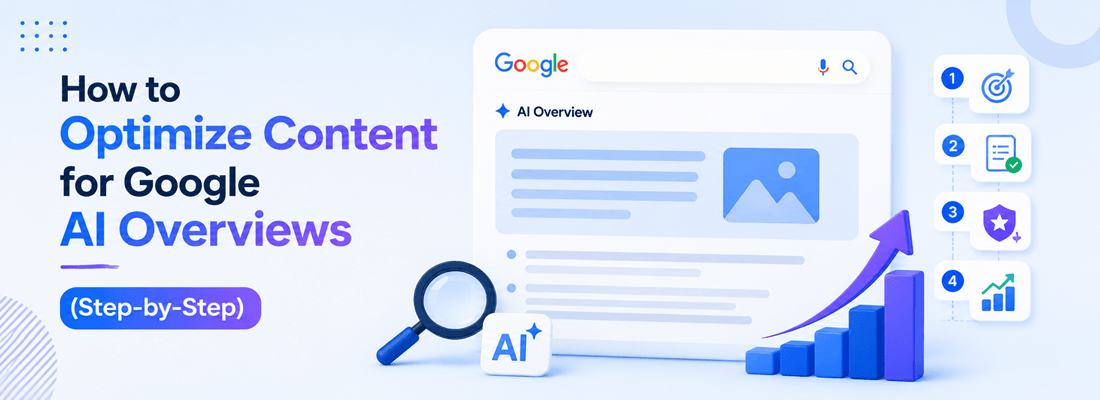
Google AI Overviews now sit above every organic result, giving users concise answers extracted from the most authoritative sources. For SEOs and content marketers, getting cited in these overviews can dramatically boost visibility, traffic, and authority. But appearing in AI Overviews isn’t about gaming algorithms; it’s about structuring content in ways AI can easily parse, demonstrating expertise, and optimizing for search intent.
In this comprehensive guide, you will understand step-by-step strategies that will allow you to optimize the content that you create for Google AI Overviews SEO.
You will learn how to properly structure your headings, create summaries that are friendly to AI, how to use schema markup, how to improve your E-E-A-T signals, and how to monitor the performance of your content with the best practices for AI SEO. By following these strategies, you can increase the likelihood that your content will be used by Google’s AI to create its overviews of the content.
Want More Traffic and Better Rankings?
Reach more customers, improve search visibility, & build a strong online presence with a clear SEO strategy.

What Does It Take to Appear in Google AI Overviews?
Getting featured in a Google AI Overview requires content that is clear, trustworthy, and easy for AI to understand.
- The core elements of E-E-A-T establish the foundation for successful content through their combination of Experience and Expertise and Authoritativeness and Trustworthiness. The content requires precise information together with verified research which needs to come from writers who possess a genuine understanding or actual hands-on experience with the subject matter.
- The process requires organized content as a fundamental requirement. The information needs to have headings and subheadings for proper organization, while bullet points, numbered lists and tables help readers scan through the content. The system enables AI to find user question answers through its identified information.
- The research demands a complete investigation of all relevant subjects that need to reach their required depth for proper analysis. You must investigate all aspects of your topic because users will search for different questions that relate to your main subject. The more complete and relevant your content, the more likely it is to be cited.
- The schema markup system functions as a signal to Google that websites use to determine their content organization. The process of adding FAQPage, HowTo and other structured data formats helps AI systems extract information that they then use to create summary displays.
By combining strong E-E-A-T, clear structure, in-depth coverage, and proper schema, your pages are much more likely to appear in Content for AI Overviews 2026.
Also Read: What Is Answer Engine Optimization (AEO)? The Complete Guide
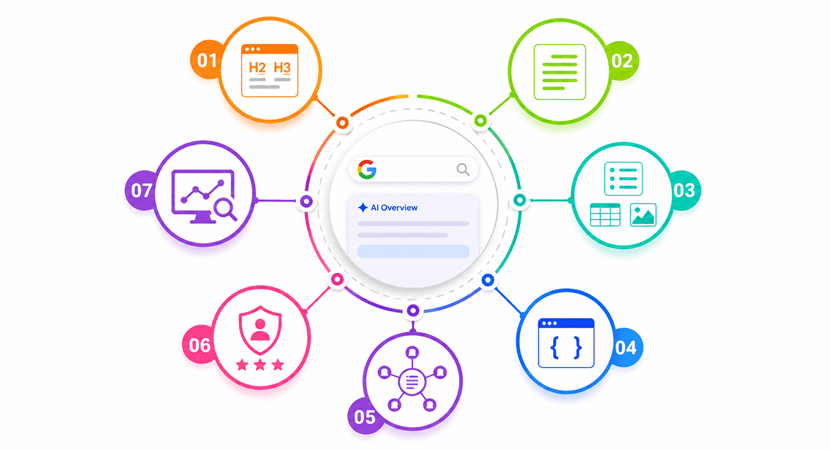
Step 1 – Write Question-Based H2 and H3 Headings
AI systems often pull content that directly answers user queries. Structuring your H2 and H3 headings as questions increases your chances of being cited.
Why it works: Headings that mirror real search queries make it easy for AI to locate concise answers and provide context in the overview.
Before / After examples:
- Before: “Social Media Marketing Tips” → After: “What Are the Most Effective Social Media Marketing Tips?”
- Before: “Benefits of Email Automation” → After: “How Does Email Automation Improve Marketing ROI?”
- Before: “SEO Checklist” → After: “What Should an SEO Checklist Include for 2026?”
Using this approach throughout your article signals relevance to AI models and improves AI SEO performance.
Step 2 – Add a 50–70 Word Summary Paragraph at the Top
A lede paragraph or summary gives AI a concise, digestible answer to the user’s question. This is the paragraph most likely to be pulled into a Google AI Overview.
Tips:
- Keep it 50–70 words.
- Answer the query immediately, no fluff.
- Include your primary keyword naturally.
Template example:
“Google AI Overviews SEO allows content to be highlighted above search results, summarizing the most authoritative information. To rank in AI overviews, structure headings as questions, provide concise answers, and implement FAQ schema. This guide outlines proven AI SEO strategies to increase your chances of being cited in 2026.”
Step 3 – Use Structured Content Formats
Structured formats make content easy to scan for both humans and AI.
Recommended formats:
- Numbered lists for step-by-step instructions.
- Comparison tables to outline pros/cons or alternatives.
- Bullet points for features, tips, or key takeaways.
Example layout (text description):
- H2: How to Optimize Blog Content for AI Overviews
- H3: Step 1 – Write Question-Based Headings
- Bullet list of best practices
- H3: Step 2 – Add a Summary Paragraph
- Numbered steps
- H3: Step 3 – Use Structured Formats
- Table comparing old vs new approaches
This layout is machine-readable, enhancing your chances for AI Overview selection.
Step 4 – Implement FAQ Schema Markup
The FAQ Page schema increases AI Overview visibility by explicitly signalling questions and answers.
Focuses on adding FAQ schema markup to your content. By using the FAQ Page schema, you inform search engines and AI systems about the questions and answers you have on your page.
This data allows Google to understand your content and include it in AI Overviews and other rich results. Adding the FAQ schema improves the visibility of your content and the user experience for those searching for your content online.
Furthermore, it also tells Google that your content is expert and authoritative regarding those questions, allowing your content to be discovered and regarded as credible online.
Step 5 – Build Topical Authority with Cluster Content
To rank in Google AI Overviews, establishing topical authority is essential. The pillar + cluster model is a proven way to do this.
- Pillar page: Covers the main topic broadly and provides a comprehensive overview.
- Cluster pages: Focus on specific subtopics and link back to the pillar page using descriptive anchor text.
Internal linking best practices:
- Link from cluster content to the pillar page clearly and naturally.
- Include relevant interlinking keywords such as AI seo agency, seo company, or seo company India.
- Ensure each cluster page addresses related questions users might ask, reinforcing your authority and improving how to rank in AI overviews.
This approach helps search engines understand your site structure, signals expertise, and increases the likelihood your content will be cited in AI Overviews.
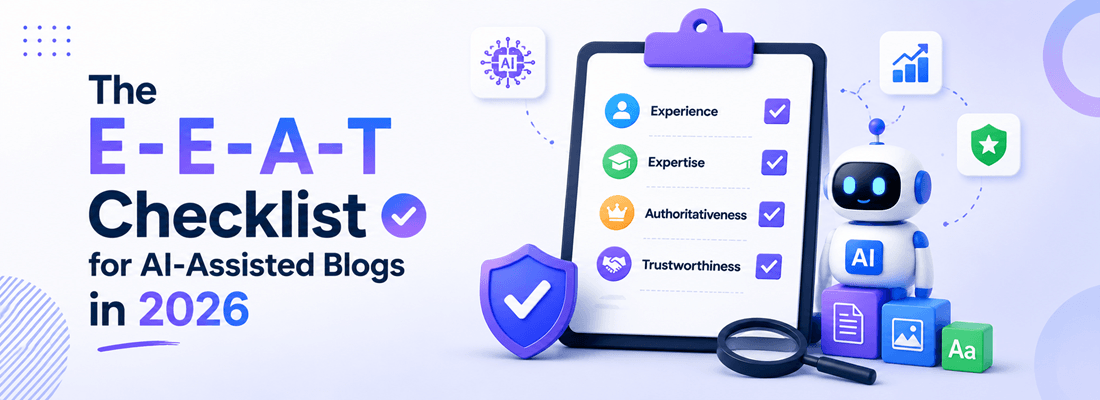
Step 6 – Strengthen E-E-A-T Signals
E-E-A-T — Experience, Expertise, Authoritativeness, and Trustworthiness — is a key factor for appearing in Google AI Overviews. It tells Google’s AI that your content is reliable and credible, which improves AI SEO performance.
Implementation tips:
- Author bios: Include clear bios that highlight the author’s expertise and relevant experience.
- Credible sources: Link to authoritative studies, official reports, or industry references to support your claims.
- About Us page: Maintain a detailed page that explains your brand’s experience, mission, and qualifications.
- Case studies: Showcase real-world examples or practical results to demonstrate proven expertise.
By combining these elements, you signal trustworthiness and authority to AI, making your content more likely to be selected for content for AI Overviews 2026.
Step 7 – Monitor Your AI Overview Appearances
Tracking where your content appears in Google AI Overviews is essential for improving your content strategy.
Methods:
- Google Search Console: Look for pages with high impressions but low click-through rates. These pages are often cited in AI Overviews.
- Manual incognito checks: Manual incognito checks allow you to perform searches on relevant questions to see if your content appears in the AI summary box.
By regularly monitoring these aspects of your content’s performance, you will see which pages are performing well, which require adjustments, and which questions need to be covered in your content more comprehensively.
Such consistent tracking of your content’s performance in AI Overviews will allow you to refine your content and implement the optimization tips that will increase the likelihood of your content being cited.
Quick Checklist Before You Publish
| Step | Action |
|---|---|
| 1 | Question-based H2/H3 headings |
| 2 | 50–70 word summary paragraph |
| 3 | Structured content (lists, tables) |
| 4 | FAQPage schema implemented |
| 5 | Internal linking to clusters and pillar pages |
| 6 | Strong author bios and citations |
| 7 | Content length 1200–2000 words |
| 8 | Include relevant keywords naturally |
| 9 | Monitor AI Overview appearances |
| 10 | Update content regularly for freshness |
Conclusion
Overall, optimizing content for Google AI Overviews SEO is not about tricking the AI — it is about structuring your content in a way that is readable, authoritative, and concise.
There are several AI overview optimization tips that you can implement to improve your chances of having your content cited by Google’s AI Overviews.
These strategies include crafting question-based headings and lede paragraphs, using schema markup, and building topical authority on the subjects that you cover on your website.
By following these strategies, you will be able to improve the visibility, credibility, and traffic to your website, making it the resource that users and Google rely on the most.
FREQUENTLY ASKED QUESTIONS
Check Google Search Console for impressions with low CTR and perform manual incognito searches to confirm.
No, it improves chances but doesn’t guarantee selection. Quality, structure, and authority matter too.
Ideally 1200–2000 words with structured headings, concise summaries, and sufficient depth.
Yes, update headings, summary paragraphs, and add schema markup to refresh them for AI recognition.
Yes, faster pages improve user experience signals, indirectly influencing selection for AI summaries.