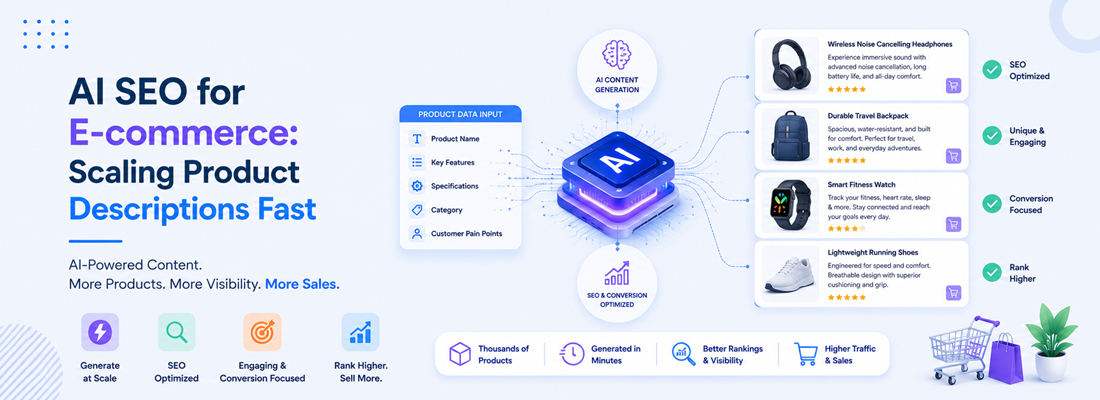
Running an online store means managing hundreds or even thousands of product pages. Each page needs clear copy, useful details, and search visibility. That becomes difficult when product catalogues grow fast.
Many e-commerce brands still use short product text from suppliers. Some repeat the same lines across pages. Others publish product pages with little information. These issues hurt rankings and reduce conversions.
This is where AI SEO helps.
Modern content systems now support faster content production for e-commerce stores. Businesses can create stronger product pages at scale without sacrificing quality. The goal is not to flood a website with content. The goal is to create useful, searchable, and customer-focused product descriptions.
Brands that invest in AI SEO Services can improve search visibility, increase organic traffic, and reduce manual work across large catalogues.
In this guide, you will learn:
- Why e-commerce product descriptions matter
- Common SEO problems online stores face
- How AI SEO supports faster scaling
- Best practices for product description creation, E-commerce, and AI SEO tips for long-term growth
Want More Traffic and Better Rankings?
Reach more customers, improve search visibility, & build a strong online presence with a clear SEO strategy.

Why Product Descriptions Matter for E-commerce SEO?
Product descriptions do more than explain a product. They help search engines understand page relevance and help shoppers make buying decisions.
Strong descriptions can:
- Improve keyword visibility
- Increase organic traffic
- Reduce bounce rates
- Build buyer confidence
- Support conversions
Weak descriptions create problems.
Many e-commerce sites:
- Copy supplier text
- Use duplicate content
- Write very short descriptions
- Ignore search intent
- Miss important keywords
Search engines prefer pages that provide useful and original information. If hundreds of websites use the same supplier copy, rankings become harder to win.
This is why e-commerce SEO AI strategies now focus heavily on scalable and unique product content.
Common E-commerce SEO Challenges
Managing Large Product Catalogues
Large stores may contain:
- Thousands of SKUs
- Seasonal collections
- Product variations
- Frequent inventory changes
Writing a unique copy for every page takes time. Many teams cannot keep up.
As a result:
- Pages stay unpublished
- Descriptions remain incomplete
- Duplicate content spreads across the site
This creates major SEO gaps.
Also Read: AI Content vs Human Intuition: Maintaining EEAT in 2026
Maintaining Content Quality
Scaling content often reduces quality. Some pages become:
- Keyword stuffed
- Repetitive
- Hard to read
- Too technical
Poor content damages user trust and search performance. Good e-commerce content needs:
- Clear structure
- Useful information
- Natural keyword placement
- Buyer-focused language
Matching Search Intent
Search intent matters more than keyword repetition. A shopper searching for:
- “lightweight running shoes”
- “waterproof travel backpack”
- “organic cotton baby clothes”
expects specific information.
Product descriptions should answer these needs directly.
This is one reason why AI SEO Services have become important for e-commerce businesses. They help brands create intent-focused product content faster.
How AI SEO Helps E-commerce Stores Scale Faster?
Faster Content Production
One of the biggest advantages of AI SEO is speed.
Instead of writing every description from scratch, ecommerce teams can quickly create structured product content. This supports:
- Faster product launches
- Better category coverage
- Improved site freshness
Large stores often struggle to update old pages. Faster workflows make regular optimisation possible.
Better Keyword Coverage
Search visibility depends on keyword relevance.
Strong product pages include:
- Primary search terms
- Product features
- Use-case phrases
- Buyer intent keywords
A good AI product description generator SEO process helps brands include these naturally within content.
This improves the chance of ranking for:
- Product searches
- Long-tail searches
- Question-based searches
Also Read: Top 7 AI Tools for Predictive SEO and Trend Analysis
Consistent Brand Voice
Consistency matters across e-commerce websites. Customers notice when:
- Tone changes between pages
- Product details feel incomplete
- Formatting looks inconsistent
Structured content systems help maintain:
- Consistent messaging
- Uniform formatting
- Clear product hierarchy
This improves both usability and trust.
Supporting Large SEO Campaigns
Scaling ecommerce SEO manually becomes difficult as stores grow. Nowadays, modern e-commerce SEO AI workflows support:
- Bulk optimization
- Product page refreshes
- Seasonal updates
- Metadata generation
- FAQ creation
This allows teams to focus more on strategy and less on repetitive writing tasks.
Key Elements of SEO-Friendly Product Descriptions
Write for Buyers First
Search visibility matters, but shoppers come first. Good product descriptions answer:
- What is the product?
- Who is it for?
- What problem does it solve?
- Why should someone choose it?
Avoid generic statements.
Instead of:
“High-quality backpack for everyday use”
Use:
“Lightweight backpack with padded straps and laptop storage for daily commuting.”
Specific details improve both readability and SEO.
Use Natural Keywords
Keyword placement should feel natural, as it should appear smoothly within the content. Try to avoid forcing keywords into every paragraph. Search engines now focus more on meaning and relevance than exact repetition.
Structure Content Clearly
Clear formatting improves readability.
Use:
- Short paragraphs
- Bullet points
- Subheadings
- Feature sections
- FAQs
This helps users scan pages.
It also supports search engine understanding.
Add Product-Specific Information
Avoid vague content.
Include:
- Materials
- Dimensions
- Features
- Use cases
- Care instructions
- Compatibility details
The more specific the content, the more useful the page becomes.
This supports stronger rankings over time.
E-commerce AI SEO Tips for Product Description Scaling
Create Content Templates
Templates improve efficiency and consistency. A strong template may include:
- Product overview
- Main features
- Benefits
- Use cases
- Specifications
- FAQs
Templates help teams scale content without losing structure.
Also Read: How Search Generative Experience (SGE) Impacts AI SEO Services
Focus on Category Intent
Different product categories require different messaging.
For example:
- Fashion products focus on style and fit
- Electronics focus on specifications
- Home products focus on functionality
Understanding category intent improves engagement and relevance. This is one of the most effective e-commerce AI SEO tips for large stores.
Refresh Old Product Pages
Older pages often lose traffic over time. But refreshing descriptions can:
- Improve rankings
- Increase relevance
- Capture new search trends
Updates may include:
- New keywords
- Better formatting
- Expanded product details
- Customer questions
SEO is not a one-time task.
optimize Metadata
Titles and meta descriptions still matter. As good metadata:
- Improves click-through rates
- Clarifies page purpose
- Supports keyword targeting
Every product page should have:
- Unique title tags
- Clear meta descriptions
- Relevant URLs
Use FAQs on Product Pages
FAQ sections improve content depth. They also support:
- Long-tail keyword targeting
- Conversational search queries
- User engagement
Example questions:
- Is this product waterproof?
- What size should I choose?
- Does this work with other devices?
FAQ content creates stronger topical relevance.
The Role of AI SEO Services in E-commerce Growth
Many e-commerce brands now use external support to manage content scaling. Professional AI SEO Services often help businesses:
- Audit product content
- Improve keyword targeting
- Build scalable workflows
- optimise technical SEO
- Refresh outdated pages
This becomes valuable for stores with:
- Large inventories
- Small internal teams
- Fast product turnover
Strong SEO systems help businesses stay competitive as search behaviour changes.
Common Mistakes to Avoid
Publishing Thin Content
Short descriptions rarely perform well. Also, pages with only one or two sentences often struggle to rank. Each product page should provide useful information.
Ignoring User Experience
SEO and usability work together. So, poor formatting, slow pages, or cluttered layouts reduce conversions. That’s why creating good content should feel easy to read.
Overusing Keywords
Keyword stuffing affects readability. So, try to use keywords naturally within sentences. Also, focus on relevance instead of repetition.
Forgetting Mobile Users
Most e-commerce traffic now comes from mobile devices.
Product pages should:
- Load quickly
- Display clearly on small screens
- Use short paragraphs
- Keep navigation simple
Mobile usability affects both rankings and conversions.
Measuring E-commerce SEO Success
Tracking performance helps identify what works. Important metrics include:
- Organic traffic
- Product page rankings
- Conversion rates
- Bounce rates
- Time on page
- Indexed pages
Content scaling should support business goals, not just publishing volume. A strong e-commerce SEO AI strategy balances:
- Speed
- Quality
- Search intent
- User experience
The Future of e-commerce Product Content
Search behaviour continues to change. Shoppers now expect:
- Detailed product information
- Fast answers
- Helpful comparisons
- Clear buying guidance
Search engines reward websites that provide useful experiences. This means e-commerce brands must move beyond basic product copy. The future of AI SEO will focus more on:
- Intent-driven content
- Deeper product expertise
- Better information structure
- Scalable optimisation systems
Businesses that improve product content now will build stronger long-term visibility.
Final Thoughts
Overall, scaling ecommerce content has always been difficult. Large product catalogues require speed, consistency, and strong optimisation. Traditional workflows often fail to keep up with modern commerce demands. This is why AI SEO has become important for growing online stores. A strong content strategy helps brands:
- Publish faster
- Improve keyword visibility
- Maintain content quality
- Support buyer intent
- Increase organic traffic
The most successful ecommerce websites treat product description AI as valuable search assets rather than basic filler text.
With the right structure and planning, businesses can scale product content efficiently while still delivering useful information to customers. As e-commerce competition grows, strong product pages will remain one of the biggest drivers of search visibility and conversions.
FREQUENTLY ASKED QUESTIONS
AI SEO enables e-commerce businesses to produce and enhance their product descriptions at a faster rate. It supports businesses to target specific keywords while expanding their content base, generating metadata, and optimising their pages for extensive product collections.
SEO for product description generators focuses on creating product descriptions that help both search engines and customers. These tools can produce detailed content that includes relevant keywords, product features, benefits, and real-world uses. The goal is to make product pages easier to find in search results while providing clear information that helps customers make buying decisions.
Yes, e-commerce SEO AI helps businesses to manage their product catalogues with more efficiency. It can create product descriptions, generate metadata, update product pages, and optimise content at scale. This reduces manual work, saves time, and helps maintain consistent quality across hundreds or thousands of product listings while improving SEO performance.
The most effective ecommerce AI SEO tips require businesses to develop original product descriptions, while they should insert keywords naturally, create FAQ sections, optimise their metadata and perform regular updates on their existing content. Businesses need to direct their attention toward search intent because they must present complete product details that enable customers to select their purchases with confidence.
Businesses should invest in AI SEO Services because they help improve search visibility, optimise product pages, and support content creation at scale. These services can assist with keyword research, technical SEO, and content optimisation, making it easier to attract relevant traffic and manage growing product catalogues. As a result, businesses can improve their online presence and support long-term e-commerce growth.