Digital marketing has changed at a fast pace over the last few years. Brands across the USA now publish more articles, landing pages, product guides, and website copy than ever before. At the same time, search engines have become stricter about quality, trust, and user value.
This shift has created a major debate around AI content vs human writing. Businesses want faster production, but they also want strong rankings, loyal readers, and trust from search engines.
Search engines now reward websites that show real experience, expert knowledge, authority, and trust. This is where EEAT matters most.
Many brands are now investing in AI SEO Services and broader AI SEO strategies to improve rankings and content workflows. Still, relying only on automation creates risks that can damage trust and visibility over time.
Want More Traffic and Better Rankings?
Reach more customers, improve search visibility, & build a strong online presence with a clear SEO strategy.

The Rise of Content at Scale
Content production used to take weeks. Now, brands can create large volumes of articles in a short time. This has changed how businesses approach search marketing.
Many companies now publish:
- Blog posts
- Product descriptions
- Service pages
- Buying guides
- FAQ sections
- Local landing pages
The pressure to stay visible in search results has pushed brands to produce more content than ever.
This growth has also increased interest in AI SEO Services because businesses want:
- Faster publishing
- Lower content costs
- Better keyword coverage
- Larger website authority
The rise of AI SEO has made content creation more accessible for small and large businesses alike. But there is one major problem. We need to understand that more content does not always mean better content.
Because search engines now look beyond keywords and volume. Instead, they focus on usefulness, relevance, and trust. That is why websites with shallow or repetitive pages often struggle to rank.
What EEAT Means in 2026
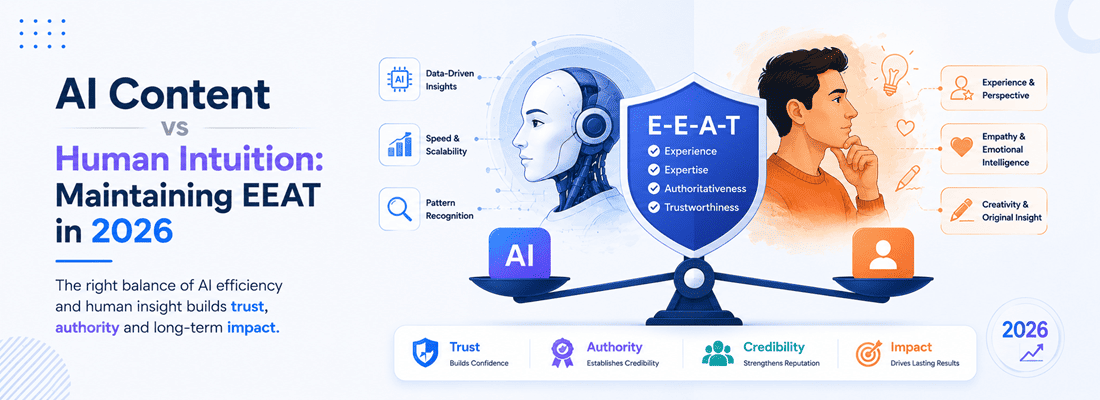
EEAT stands for:
- Experience
- Expertise
- Authoritativeness
- Trustworthiness
These signals help search engines understand whether content deserves visibility.
Experience
Experience means the writer has real involvement with the topic.
For example:
- A traveller sharing a hotel review
- A fitness coach discussing training plans
- A business owner explaining customer growth
Real experience creates depth that generic writing often lacks.
Expertise
Expertise shows strong knowledge in a subject area.
Search engines now favor content written by people who understand the topic well.
This matters more in industries such as:
- Health
- Finance
- Legal services
- Technology
- Business consulting
Strong expertise improves user trust and increases engagement.
Authoritativeness
Authority develops over time.
It comes from:
- Consistent quality
- Industry recognition
- Strong backlinks
- Mentions across trusted websites
- Positive brand reputation
Websites that build authority usually perform better in competitive search results.
Trustworthiness
Trust is now one of the biggest ranking factors.
Search engines want websites that:
- Provide accurate information
- Protect user data
- Avoid misleading claims
- Show transparency
Trust affects both rankings and conversions.
Without trust, even well-written pages struggle to perform.
Also Read: Top 7 AI Tools for Predictive SEO and Trend Analysis
Why EEAT SEO Matters More Than Ever
The internet is now flooded with repetitive content. Many articles say the same thing with slightly different wording.
This has made EEAT SEO one of the most important strategies for long-term visibility. Search engines now reward websites that:
- Solve real problems
- Offer original insights
- Show first-hand knowledge
- Provide reliable information
This change has shifted the focus from quantity to quality.
Businesses that ignore EEAT SEO may see:
- Falling rankings
- Lower engagement
- Reduced trust
- Weak conversion rates
In 2026, search visibility depends on credibility as much as optimization.
The Risks of Fully Automated Content
Many businesses believe automation alone can solve their content needs. While speed helps, there are serious risks when content lacks human review and insight.
Generic Information
One common problem is repetition.
Many pages cover:
- The same advice
- The same examples
- The same structure
This creates content that feels flat and forgettable.
Users leave quickly when they do not find anything useful or unique.
Lack of Real Experience
Search engines now value first-hand insight.
A page without:
- Personal examples
- Real case studies
- Industry understanding
Often feels weak, which is one of the biggest issues in the AI content vs human debate.
Human intuition adds:
- Perspective
- Emotion
- Context
- Practical advice
These qualities improve trust and readability.
Also Read: Why Businesses are Outsourcing to AI SEO Services in India
Factual Errors
Automated systems can sometimes:
- Misinterpret information
- Present outdated details
- Oversimplify complex topics
In industries where accuracy matters, this creates major risks.
Because incorrect information damages both trust and authority.
Weak Brand Voice
Brands need consistency. Without careful editing, content may lose:
- Personality
- Tone
- Brand identity
Readers connect with brands that sound natural and relatable.
That human connection still matters in 2026.
AI Content vs Human Intuition
The discussion around AI content vs human writing often becomes extreme. Some people believe automation will replace writers completely.
While others believe human-only content is the only safe approach. The truth sits somewhere in the middle.
Where Automation Helps
Modern content systems help businesses:
- Organize topics
- Structure outlines
- Identify search trends
- Improve workflow speed
- Scale content planning
This support can improve efficiency. Many brands now combine AI SEO processes with human strategy to manage large websites.
Where Human Intuition Wins
Human writers still bring qualities that machines cannot fully replicate.
These include:
- Storytelling
- Emotional understanding
- Real-world experience
- Industry judgment
- Audience awareness
Human intuition helps content feel authentic, which is especially important for:
- Opinion pieces
- Buying advice
- Industry analysis
- Customer education
- Brand storytelling
Search engines increasingly reward these qualities because users value them.
AI vs Human Content SEO: What Search Engines Prefer
The future of AI vs human content SEO is not about choosing one side. Search engines care about results.
They ask:
- Is the page useful?
- Does it solve the user’s problem?
- Does it show expertise?
- Can people trust it?
Content that meets these standards performs well. Also, content that feels thin or misleading struggles.
This means businesses should focus less on how content is produced and more on:
- Accuracy
- Clarity
- Originality
- User value
That is the real future of AI and human content SEO.
The Best Balance Strategy for 2026
The strongest content strategies now combine efficiency with human expertise. This balanced approach protects EEAT while improving scalability.
Start With Human Strategy
Every content plan should begin with people.
Brands need to define:
- Audience needs
- Search intent
- Business goals
- Brand messaging
Without clear direction, content loses focus. This is where human strategy creates purpose.
Use Systems for Structure
Content systems can support:
- Topic clustering
- Content planning
- Keyword mapping
- Draft organisation
This saves time during production. Many businesses using AI SEO Services now focus on workflow improvement rather than full automation.
Add Human Insight
This is the most important step. Writers should include:
- Personal observations
- Expert commentary
- Customer experiences
- Practical lessons
- Industry trends
These details improve trust and make content stand out.
Edit Carefully
Editing is still important because good editing improves:
- Accuracy
- Readability
- Flow
- Consistency
It also removes repetitive language and improves clarity.
Best Practices for Maintaining EEAT in 2026
Create Content for People First
Do not write only for rankings.
Focus on:
- Helping readers
- Solving problems
- Answering questions clearly
User satisfaction improves long-term performance.
Use Real Examples
Examples increase credibility. Readers trust content that includes:
- Case studies
- Real situations
- Practical outcomes
Experience is now a core part of EEAT SEO.
Keep Information Updated
Outdated content loses trust. So, review pages regularly to:
- Refresh statistics
- Update advice
- Remove broken links
- Improve relevance
Fresh content supports stronger rankings.
Build Author Profiles
Show who wrote the content. Author pages should include:
- Experience
- Qualifications
- Industry background
This helps search engines understand expertise.
Strengthen Website Trust
Trust signals matter more than ever. Useful trust elements include:
- Secure websites
- Clear contact information
- Transparent policies
- Customer reviews
- Accurate claims
Trust supports both rankings and conversions.
Focus on Search Intent
Every page should match user intent.
Ask:
- What problem is the user trying to solve?
- What information do they expect?
- What action do they want to take?
Content that aligns with intent performs better.
Avoid Thin Content
Do not publish pages with little value. Low-quality pages weaken overall authority.
Instead, create:
- Detailed guides
- Helpful resources
- Strong topic coverage
Quality matters more than volume.
EEAT Guidelines 2026: What Businesses Should Expect
The evolving EEAT guidelines 2026 point towards one clear direction: trust-driven search. Search engines are becoming better at identifying:
- Genuine expertise
- Helpful information
- Authentic experience
- Reliable websites
Businesses should expect:
- Stronger quality checks
- Greater focus on credibility
- More emphasis on the author’s reputation
- Better evaluation of user satisfaction
This means websites must invest in:
- Skilled writers
- Expert reviews
- User-focused content
- Consistent quality standards
The future of EEAT guidelines 2026 is centered on trust and authenticity.
Why Human-Led Content Still Matters
Technology can improve speed, but it cannot fully replace human understanding.
People connect with:
- Stories
- Emotions
- Experiences
- Honest opinions
Readers remember content that feels real because human-led content also helps brands:
- Build loyalty
- Increase engagement
- Improve conversions
- Develop authority
This is why many successful businesses now combine AI SEO Services with strong editorial oversight.
The Future of AI SEO
The future of AI SEO will likely focus on collaboration between systems and human expertise.
Businesses that succeed will:
- Use automation wisely
- Protect brand quality
- Prioritize user trust
- Maintain strong editorial standards
Search engines will continue rewarding websites that provide genuine value. That means shortcuts will become less effective over time. Sustainable growth will come from:
- Strong strategy
- Useful content
- Clear expertise
- Consistent trust
Conclusion
Overall, the debate around AI content vs human writing will continue in 2026 and beyond, but the answer now looks much clearer. Search engines do not favor content just because brands create it fast or at a large scale; they value content that truly guides and supports people.
That is why EEAT matters more than ever. Businesses should use modern systems to speed up work while keeping human expertise at the heart of their content strategy. The best approach blends smart workflows, human judgment, real experience, clear authority, and genuine trust. This balance helps brands create content that ranks well, builds credibility, and keeps readers interested.
The future of AI vs human content SEO does not depend on choosing one over the other. Instead, it depends on blending efficiency with authenticity to better support real people in the USA and the global market.
FREQUENTLY ASKED QUESTIONS
EEAT stands for Experience, Expertise, Authority, and Trustworthiness. These signals help search engines judge content quality and trust.
EEAT SEO matters because search engines now favor trustworthy and experience-based content over generic information.
Yes, but only when it gives useful, accurate, and valuable information. Human review and expertise still play an important role in long-term success.
The future of AI-powered SEO blends fast workflows with human strategy, editing, and expertise to create better experiences for users.
Businesses can follow the EEAT guidelines 2026 by:
- Publishing expert-led content
- Using real examples
- Maintaining accuracy
- Building trust
- Keeping content updated regularly