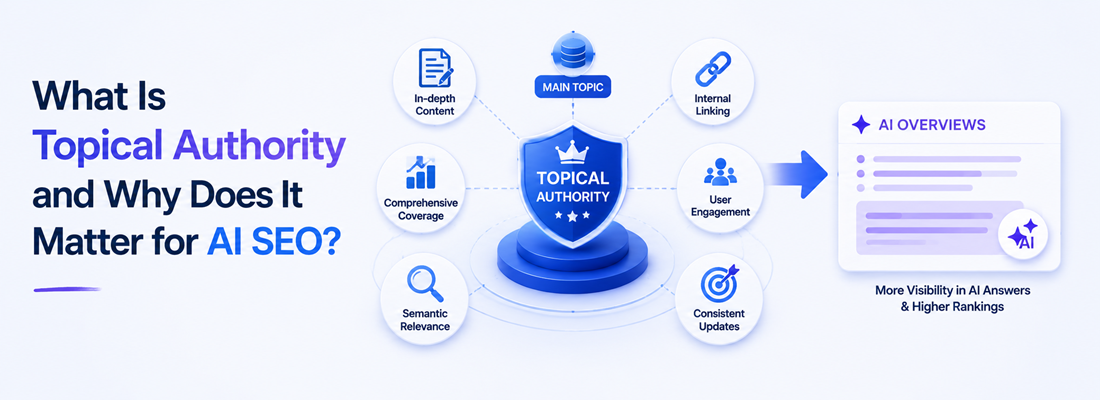
Google’s AI doesn’t just cite the best page, as it cites the most trusted source on a topic. That’s a major shift in how search works today.
For years, SEO teams focused on ranking single pages for specific keywords. If a page reached the top of the search results, many people saw the job as complete. Today, search systems look beyond one page. They check whether a website shows strong knowledge across an entire subject. This is where Topical Authority SEO becomes important.
Search engines now connect topics, entities, user intent, and content relationships. A website that explores a topic from many angles stands a better chance of becoming a trusted source. This helps improve visibility in both traditional search results and modern search experiences.
In this guide, you’ll learn what Topical Authority in SEO means, why it matters for AI SEO, and how to build a content strategy that strengthens your authority over time.
Want More Traffic and Better Rankings?
Reach more customers, improve search visibility, & build a strong online presence with a clear SEO strategy.

What Is Topical Authority in SEO?
Topical Authority means a website shows deep knowledge and broad coverage of a specific subject.
Instead of publishing one article about a topic, authoritative websites build a network of related content that answers many user questions.
For example, a website focused on email marketing may create content about:
- Email automation
- List building
- Deliverability
- Segmentation
- A/B testing
- Email analytics
- Compliance regulations
Together, these articles paint a clear picture of expertise.
The goal of Topical Authority SEO is to show search engines that your website serves as a trusted resource for a complete topic rather than a collection of separate pages.
Topical Authority vs Domain Authority
Many people mix up topical authority and domain authority, but they mean different things.
Domain authority looks at the overall strength of a website. Topical authority focuses on knowledge within a specific subject. A newer website can build strong authority in one niche even if it has fewer backlinks than a larger competitor.
Why Does Topical Authority Matter More in AI-Driven Search?

Search systems now understand context much better. Instead of matching keywords alone, they connect topics, entities, and user questions. This shift makes AI SEO depend more on content depth than ever before.
When search systems generate answers, they often favour sources that explore an entire subject. A website with broad coverage usually appears more trustworthy than a website with one well-optimised page.
Research across the SEO industry shows a clear trend:
Websites with 10 or more interconnected articles around a topic often earn more citations in search-generated answers than websites with isolated content.
This happens because search systems can clearly spot:
- Topic relevance
- Subject expertise
- Content relationships
- User intent coverage
For agencies and in-house teams, ranking individual keywords no longer solves the whole puzzle. The focus must move toward building complete topic ecosystems.
This is one reason why businesses investing in AI based SEO services place greater attention on topic clusters, content relationships, and organised site structures.
How Does Google Measure Topical Authority?
Google does not share a specific topical authority score. However, several signals help search systems decide whether a website shows expertise on a topic.
Entity Recognition
Search engines recognise entities rather than just keywords. An entity can include:
- A person
- A company
- A product
- A concept
- A location
When your content consistently explores related entities within a subject area, it strengthens topical relevance.
For example, a CRM software website may discuss:
- Sales pipelines
- Lead management
- Customer retention
- Reporting dashboards
These connected entities reinforce expertise.
Internal Links
Internal links help search engines connect related pages. A strong content structure ties articles together in a logical way. This creates a clear topical map that search engines can follow.
Co-Citations
Co-citations happen when people mention your brand alongside respected industry sources. These mentions strengthen relevance and trust.
Knowledge Graph Connections
Google’s Knowledge Graph links entities and topics together.
When your content aligns with recognised concepts and covers a topic thoroughly, search engines can connect your website to that subject more easily. Together, these signals help shape your level of Topical Authority in SEO.
How to Build Topical Authority: Step-by-Step
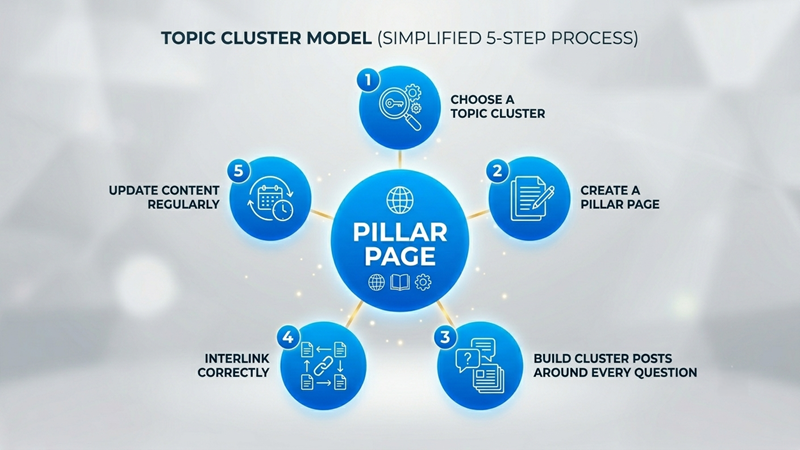
Building authority takes planning and consistency. If you’re wondering how to build Topical Authority, follow these five steps.
1. Choose a Topic Cluster
Start with a broad topic that matches your business goals. For example:
Core Topic: Local SEO
Possible subtopics:
- Google Business Profile
- Local citations
- Local keyword research
- Review management
- Location pages
Choose a topic where you can create useful content for a long time.
2. Create a Pillar Page
A pillar page acts as the main guide for the topic. It gives readers a broad overview and links to supporting content. For example:
Pillar Page: Complete Guide to Local SEO
Supporting pages:
- Local keyword research guide
- Citation building guide
- Local ranking factors
- Review optimisation
The pillar page anchors the entire cluster.
3. Build Cluster Posts Around Every Question
Next, create content that explores every major angle.
Think about:
- Beginner questions
- Comparison topics
- Advanced strategies
- Industry trends
- Common mistakes
The goal is complete coverage.
Ask yourself:
“What would someone need to learn to understand this topic well?”
Then create content that answers those questions.
4. Interlink Correctly
Internal linking often gets overlooked. Every supporting article should connect to:
- The pillar page
- Related cluster content
This creates strong content relationships. A clear internal linking system helps search engines understand topic depth. It also helps visitors move through your content more easily.
5. Update Content Regularly
Authority does not stay still. Industries change. User needs evolve. Search systems reward fresh and accurate information. Review important content regularly and refresh:
- Statistics
- Examples
- Screenshots
- Recommendations
This keeps your topic cluster useful and relevant.
Topical Authority vs. Domain Authority: What’s the Difference?
The two concepts serve different purposes.
| Factor | Topical Authority | Domain Authority |
|---|---|---|
| Focus | Expertise in a specific topic | Overall website strength |
| Scope | Topic-specific | Site-wide |
| Content Importance | Very high | Moderate |
| Backlink Importance | Important | Very important |
| New Site Potential | High | Limited initially |
| Search Relevance | Topic-based | Domain-based |
A website with lower domain authority can still outrank larger competitors when it develops stronger Topical Authority SEO within a niche.
How Many Articles Do You Need for Topical Authority?
One of the most common questions asks how much content you need. The truth is simple. No magic number exists. Authority grows from topic coverage rather than article count.
For a smaller niche:
- 10–20 articles may build strong coverage.
For a competitive industry:
- 50–100 articles may be necessary.
The key factor remains depth.
Consider these two examples:
Website A
- 100 short articles
- Minimal depth
- Limited internal linking
Website B
- 20 detailed articles
- Strong topic coverage
- Excellent internal linking
Website B often develops stronger authority. Quality and relevance matter more than quantity alone.
When planning content, focus on answering important user questions instead of chasing a specific article target.
Real Examples of Topical Authority Done Right
Topical authority is built when a website covers a subject comprehensively rather than publishing a single article on it. The following examples show how businesses can create a strong content structure that demonstrates expertise and improves visibility in search results.
Example 1: Cybersecurity Website
A cybersecurity website may choose Cybersecurity for Small Businesses as its pillar topic. To support this topic, it can create detailed content around related areas such as phishing prevention, password management, endpoint protection, security audits, employee training, and incident response planning.
Pillar Topic
Cybersecurity for Small Businesses
Supporting Content
- Phishing Prevention
- Password Security
- Endpoint Protection
- Security Audits
- Employee Training
- Incident Response
Each supporting article addresses a specific aspect of cybersecurity while linking back to the main guide. Together, these pages demonstrate broad and in-depth expertise, helping search engines recognise the website as a trusted source on cybersecurity.
Example 2: Healthcare Marketing Website
A healthcare marketing website bases its content development on the fundamental subject of Healthcare Digital Marketing. The supporting content needs to cover patient acquisition strategies, medical SEO, healthcare content marketing, compliance requirements, reputation management and conversion optimisation.
The website offers complete healthcare marketing resources which cover all essential elements that healthcare organisations need to succeed. The complete content selection creates strong subject matter authority which helps websites rank for more related search terms.
Example 3: SEO Agency Website
An SEO agency uses Search Engine Optimisation as its main focus while producing additional content about technical SEO, local SEO, content strategy, link building, reporting, search intent analysis and site audits.
The agency demonstrates its full range of SEO skills through this cluster system which shows all of their expertise instead of just one service area. The AI SEO service providers show their expertise through this method which helps them establish better topic connections while gaining trust from web visitors and search engine platforms.
The examples demonstrate that creating topical authority requires more than a single article. The development process involves building a network of connected content that provides complete subject information through multiple perspectives.
How to Track Your Topical Authority Progress?
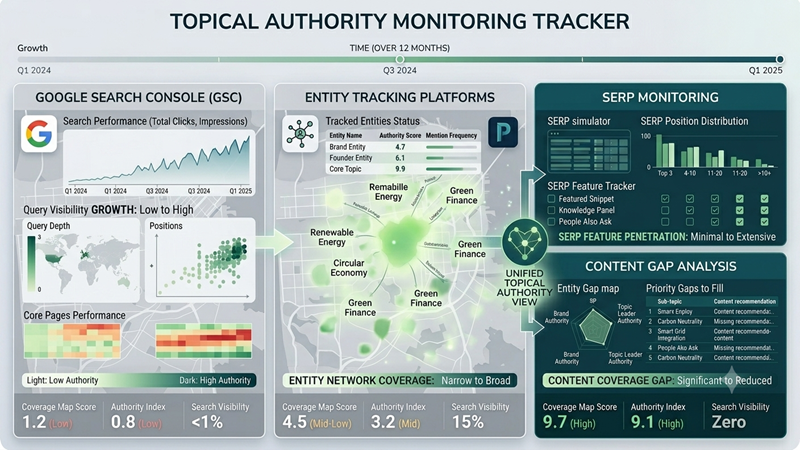
Building authority takes time. Tracking progress helps uncover growth opportunities.
Google Search Console
Google Search Console offers valuable insights into:
- Search impressions
- Clicks
- Ranking trends
- Topic-related queries
Monitor growth across entire topic clusters rather than individual pages.
Entity Tracking Platforms
Many SEO platforms track entity relationships and topic visibility. These insights reveal whether search engines connect your website with target subjects. When reviewing a Topical Authority tool, look for features that support:
- Topic mapping
- Entity analysis
- Content gap identification
- Internal link analysis
A good Topical Authority tool should highlight missing content opportunities.
SERP Monitoring
Track rankings across your topic cluster. Look for improvements in:
- Keyword visibility
- Topic ownership
- Featured snippets
- Search-generated answer citations
Authority growth often appears across clusters before major ranking gains arrive.
Content Gap Analysis
Review competitor coverage regularly.
Ask:
- What topics do they cover?
- Which questions remain unanswered on our site?
- Which supporting pages are missing?
Closing these gaps strengthens authority.
Many organisations that invest in AI-based SEO services prioritise content gap analysis because it reveals new ways to expand topic coverage.
Conclusion
Search has moved beyond simple keyword matching. Today, visibility depends on showing expertise across entire subject areas.
Topical Authority SEO helps search engines recognise your website as a trusted source on a topic. It combines comprehensive content, strong internal linking, entity relevance, and regular content updates.
For businesses focused on AI SEO, topical authority has become a key advantage.
The process remains simple:
- Choose a topic cluster.
- Build a pillar page.
- Create supporting content.
- Link pages together.
- Update content regularly.
Over time, this approach strengthens trust, improves visibility, and increases the likelihood that search systems will recognise your website as a leading source in your niche.
Rather than focusing on individual keywords, focus on becoming the best resource for an entire topic. That is how lasting authority grows.
FREQUENTLY ASKED QUESTIONS
Generally, most websites begin to experience the growth of their topical authority in a period ranging from three to six months. However, in cases of highly competitive industries, the time taken to establish authority can be significantly longer.
Yes, it is possible for a new website to establish its topical authority. Small websites that specialise in particular subjects can challenge big established websites when they develop complete content about their chosen topics.
While both are important for developing a website’s SEO, topical authority and backlinks play different roles. Topical authority indicates a website’s expertise on a subject, while backlinks display trust in that website from other sites. The most effective SEO strategies incorporate both elements.
Yes. Websites that cover topics comprehensively often have a stronger chance of appearing in search-generated answers and AI Overviews.
Several SEO platforms support topic mapping, entity analysis, content gap research, and visibility tracking. When choosing a Topical Authority tool, focus on features that measure topic coverage and content relationships rather than keyword rankings alone.