
FAQ schema markup is a type of structured data that helps search engines understand the questions and answers on a webpage. By clearly identifying FAQ content, it makes it easier for search engines and AI-powered search experiences to interpret, extract, and reference your information.
Without an FAQ schema, a search engine must analyze your page and determine which content represents questions and answers. With the FAQ schema in place, that information is clearly labelled and organized, reducing ambiguity and improving content understanding.
In this guide, you will learn what FAQ schema markup is, why it plays an important role in AI Overviews, and how to implement it correctly to improve your content’s visibility in modern search experiences.
Want More Traffic and Better Rankings?
Reach more customers, improve search visibility, & build a strong online presence with a clear SEO strategy.

What Is FAQ Schema Markup?
FAQ schema markup acts like a name tag for your content. It points to Google and announces, “This sentence is a question, and this paragraph next to it holds the answer to that question.”
The code follows a language called JSON-LD. You add this code to the <head> section of your webpage. Or you nestle it near the bottom, just before the closing </body> tag. Here is a simple example of the code for one question.
{
“@context”: “https://schema.org”,
“@type”: “FAQPage”,
“mainEntity”: [{
“@type”: “Question”,
“name”: “How long does it take to bake a cake?”,
“acceptedAnswer”: {
“@type”: “Answer”,
“text”: “Most cakes take 25 to 35 minutes to bake at 180 degrees Celsius.”
}
}]
}
You do not need to be a developer to use this. Many content management systems offer simple ways to add FAQ markup without touching code. But understanding the basics helps you control exactly how your content appears to AI engines.
Why Does FAQ Schema Help with Google AI Overviews?
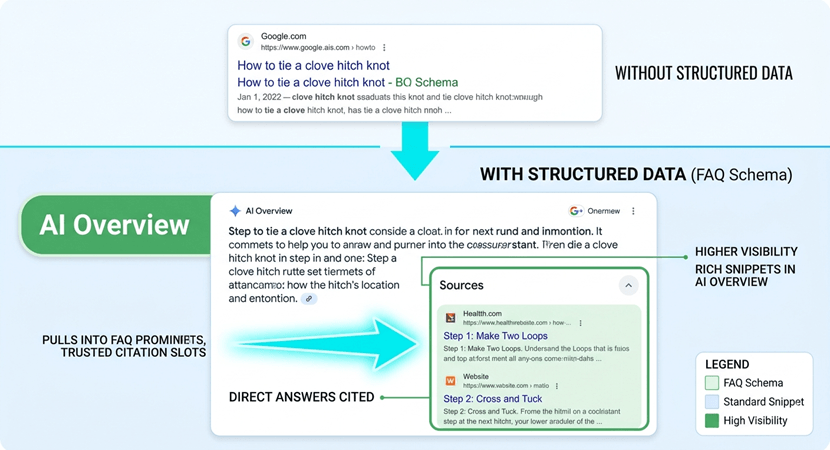
AI Overviews scan webpages to find straightforward answers that users can trust for their questions. Structured data operates as a navigational system that helps AI systems find their destinations. The SEO method of structured data removes all need for guessing. The AI system operates without needing to identify question content from answer content during its operations. You tell it directly.
Research shows that pages with an FAQ page schema get cited more often in AI-generated answers compared to pages without it. AI models select definite answers because they need clear answers to perform their tasks. The system identifies the exact content it needs to extract through its detection of FAQPage types and acceptedAnswer properties.
Think of two restaurants. One gives you a menu with clear sections for starters, mains, and desserts. The other gives you a sheet of paper with ingredients listed randomly. You will order from the first restaurant every time. FAQ schema SEO is that clear menu for AI engines.
How to Write FAQs That AI Engines Actually Use?
Adding the code is only half the work. The quality of your answers determines whether AI systems choose your content. Follow these three rules for every FAQ you write.
- Rule one: Write complete answers. Each answer must make sense on its own. AI systems often pull a single Q&A without showing the rest of the page. Do not write answers that say “as mentioned above” or “see the previous section.”
- Rule two: Keep answers between 40 and 60 words. This length gives enough detail without overwhelming the reader or the AI. Shorter answers lack substance. Longer answers become hard to extract cleanly.
- Rule three: Answer the question immediately. Start with the direct answer, then add supporting details. Do not bury the answer in a long story.
Here is a comparison of good versus bad FAQ answers.
| Question Type | Bad Example | Good Example |
|---|---|---|
| What is a VPN? | A VPN is something that helps with online privacy and security and many people use it for various reasons. | A VPN (Virtual Private Network) creates an encrypted connection between your device and the internet. This encryption hides your online activity from your internet provider and public Wi-Fi networks. |
| How often should I change my toothbrush? | You should change it every few months depending on how it looks. | Dentists recommend changing your toothbrush every three months. Worn bristles clean less effectively and can harbour bacteria. Set a calendar reminder to replace your toothbrush at the start of each season. |
| Is coffee good for you? | Yes, it has some benefits but also some downsides depending on how much you drink. | Moderate coffee consumption of two to three cups per day is linked to lower risks of heart disease and type 2 diabetes, according to multiple studies. Drinking more than five cups may increase anxiety and sleep problems. |
How to Add FAQ Schema to Your Website?
You have several options to add FAQ schema markup to your site. Pick the method that matches your technical comfort level.
Method one: Use your content management system. The majority of current platforms provide their users with built-in FAQ schema markup tools and additional extension options. Look for a setting or block labelled “FAQ” when you edit a page. The system generates code automatically through its question-and-answer input feature.
Method two: Write the code yourself. Copy this template and replace the example questions with your own.
<script type=”application/ld+json”>
{
“@context”: “https://schema.org”,
“@type”: “FAQPage”,
“mainEntity”: [
{
“@type”: “Question”,
“name”: “What is the return policy?”,
“acceptedAnswer”: {
“@type”: “Answer”,
“text”: “We accept returns within 30 days of purchase. Items must be unused and in original packaging. Customers pay return shipping unless the item arrived damaged.”
}
},
{
“@type”: “Question”,
“name”: “How long does delivery take?”,
“acceptedAnswer”: {
“@type”: “Answer”,
“text”: “Standard delivery takes three to five business days. Express delivery takes one to two business days. Orders placed before 2 PM ship the same day.”
}
},
{
“@type”: “Question”,
“name”: “Do you offer international shipping?”,
“acceptedAnswer”: {
“@type”: “Answer”,
“text”: “Yes, we ship to Canada, Australia, and most European countries. International delivery takes seven to fourteen business days. Customers are responsible for customs fees and import taxes.”
}
}
]
}
</script>
Paste this code into the <head> section of your webpage or just before the closing </body> tag.
Method three: Use a tag manager. A tag manager lets you add code to your site without editing files directly. Create a new custom HTML tag, paste your JSON-LD code into it, and set the tag to fire on pages where you have visible FAQ content.
How to Test and Validate Your FAQ Schema?
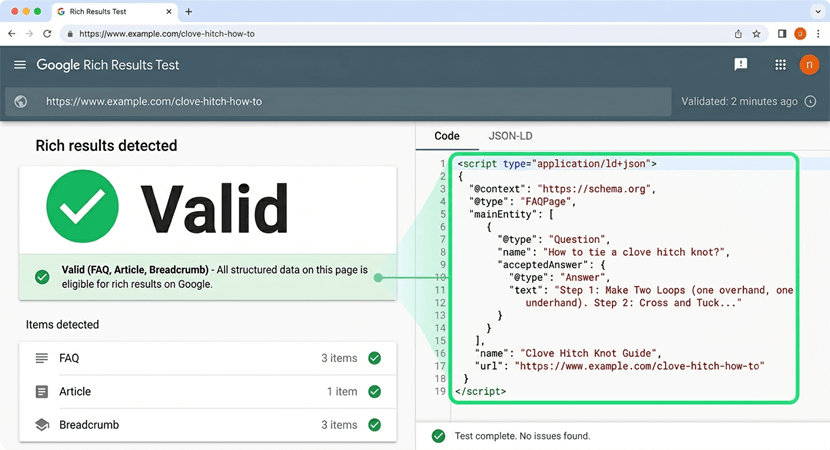
Adding the code is not the final step. A single missing comma or quote mark breaks your FAQ schema markup. Search engines and AI systems ignore broken code completely.
Use a Free Testing Tool
The Rich Results Test is the best tool available. Open it in your browser. Enter your webpage URL or paste your code directly into the tool. Click the test button.
Read the Results
Green check marks mean your FAQ schema markup is valid. Red error messages tell you exactly what needs fixing. Fix every error before publishing.
Run a Second Validation
Also, test your page through the Schema Markup Validator. This tool catches technical errors that Google’s tool might miss. It checks for proper syntax and property names.
Test Every Time
Run both tests each time you add new FAQ markup to a page. Do not assume your code works just because it worked last week. A small typo breaks everything. Validation takes two minutes and saves you from invisible failures that hurt your AI Overview rankings.
Common FAQ Schema Mistakes That Hurt Your Rankings
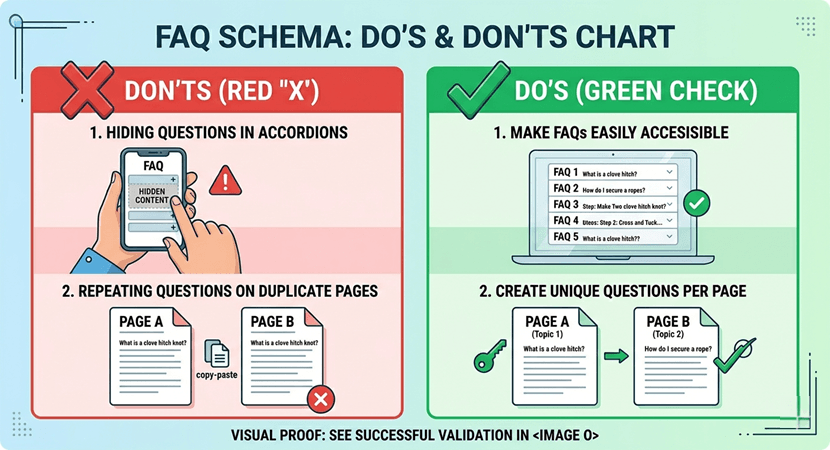
Avoid these five errors to keep your FAQ schema markup working properly.
Hiding Questions Inside Tabs
The full text of every question and answer must be visible when the page loads. Google identifies hidden content within accordion elements and expandable tabs as non-compliant with their guidelines. Users need to interact with content before web crawlers can access it.
Writing Answers That Do Not Answer
Stay on topic. The FAQ section should not include product promotion activities. Provide the required answer straight away through your first sentence. The page needs to place promotional content in locations which differ from its existing position.
Using the Same Questions on Multiple Pages
Each page needs unique FAQ content. The practice of showing identical Q&A content throughout your website triggers search engines to treat your site as deceptive. Create new questions for every product and service page that you need to display.
Adding Too Many FAQs
The website should display between five and ten questions on each page. Readers will experience information overload when you provide more than ten answers because it reduces the impact of each response. The first order of business should involve handling actual customer inquiries, which support tickets and search data reveal.
Skipping Validation
The FAQ schema markup remains inactive because it receives no validation feedback. The page appears correct to human visitors but AI engines cannot detect any content. The entire code fails because of a missing comma or unescaped quote. Use the Rich Results Test tool before publishing. Validate every time
FAQ Schema vs. Q&A Schema: Which Should You Use?
These two markup types serve different purposes. Use the right one for your situation.
| Feature | FAQ Schema | Q&A Schema |
|---|---|---|
| Who writes the answers? | The page owner or website publisher provides the answer. | Multiple users within a community can contribute answers. |
| Where does it belong? | Product pages, service pages, help centres, FAQs, and blog posts. | Forums, discussion boards, and community Q&A websites. |
| Can users add answers? | No. Each question has one official answer provided by the website. | Yes. Users can submit and vote on multiple answers. |
| Example use case | “What sizes does this shirt come in?” asked the retailer. | “How do I fix error code 403?” was answered by various users with different solutions. |
If you run a standard business website with a help section or product FAQ page, use FAQ schema SEO. If you run a community forum where users ask and answer questions, use the Q&A schema.
Conclusion
FAQ schema markup is your direct line to appearing in AI Overviews. The code is simple to add, free to implement, and supported by every major search engine and AI platform. Pair the correct markup with clear, complete answers of 40 to 60 words each. Test your work with free validation tools. Avoid common mistakes like hiding content or duplicating questions across pages. The process of search evolution has led AI-generated answers to become more important than ever so structured data now holds greater value. The websites that adopt FAQ page schema today will establish their base for future online discoverability.
An AI SEO expert or an AI SEO company in India can help you start your project quickly while maintaining proper industry standards.
Multiple AI SEO platforms now provide schema markup as a basic element that they include in their service packages. Start with one page this week. Add your FAQs, apply the markup, validate the code, and watch for your content to appear in those AI Overview citation boxes.
FREQUENTLY ASKED QUESTIONS
No. FAQ schema markup improves your chances but does not guarantee placement. Schema tells the engine where to look. Your content quality decides if the engine picks it.
Add five to ten questions per page. Fewer than five adds little value. More than ten overwhelms readers. Focus on the questions real customers often ask.
Yes. Product pages work well for the FAQ page schema. Answer genuine customer questions about shipping, returns, sizing, and warranty. Keep answers informational. No sales copy disguised as questions.
Yes, but the value shifted. Google restricted visible FAQ rich results in 2023. However, FAQ markup remains vital for AI Overviews, ChatGPT, and other AI platforms. The code works fine for AI citations even without dropdowns in traditional search.