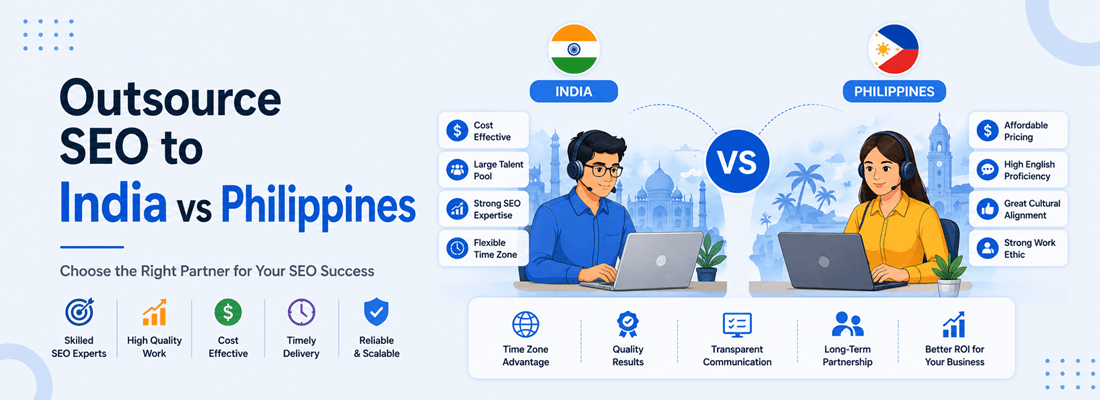
Many companies now look beyond their borders for skilled help. India and the Philippines often rank highest for digital marketing support. This article addresses the India vs Philippines SEO outsourcing question to help businesses pick the right path. Organizations will learn how each country stacks up in cost, communication, and work style.
Both locations offer talented employees ready to handle SEO tasks. Yet they differ in important ways. Some differences involve speaking styles, time zones, and job focus. This breaks down those points without pushing any single choice. By the end, readers will see why India holds a strong edge for SEO work.
Want More Traffic and Better Rankings?
Reach more customers, improve search visibility, & build a strong online presence with a clear SEO strategy.

Quick Comparison Overview
Before exploring each area in detail, it’s important to compare the two countries. A summary table shows the main differences between them. This table serves as a guide for the following sections and provides a clear framework for the upcoming discussions.
| Feature | India | Philippines |
|---|---|---|
| English fluency | Very high with clear vocabulary | High with American influence |
| Cost for SEO work | Lower for specialized tasks | Moderate for basic services |
| Time zone difference | 10-13 hours behind US (flexible) | 12-15 hours ahead (night shift common) |
| Technical SEO skills | Deep and wide | Growing but narrower |
| Scaling ability | Large talent pool | Smaller pool |
Philippines vs. India: Call Center Outsourcing
Many businesses first think of call centers when comparing these two nations. The Philippines has built a strong name in voice support over the past twenty years. Agents there speak with a neutral accent that suits phone conversations well. This makes them a popular pick for customer service roles.
India also runs many call centers, but its strength lies elsewhere. Indian employees are highly skilled in providing written support and technical troubleshooting. They handle complex queries that need more than a scripted answer. For SEO work, this difference matters a lot. SEO demands deep analysis, not just polite conversation.
Here are the ways call center work differs between the two countries:
- Voice tone and accent. Filipino agents use a neutral, American-influenced accent. Indian agents speak clearly but with a distinct rhythm that some listeners need time to adjust to.
- Problem-solving depth. Indian employees dig into technical issues without transferring calls. Philippine agents follow scripts more closely and escalate complex problems to supervisors.
- Written follow-through. Indian teams send detailed email summaries after each call. Philippine teams focus more on resolving issues during the phone conversation itself.
- Training background. Indian call center staff often hold engineering or commerce degrees. Philippine agents receive strong soft skills training but less technical education.
When a business chooses to outsource SEO to India, it taps into a workforce trained for logic and data. Philippine employees shine in friendly phone chats. Indian professionals shine in solving puzzles and spotting trends. For search engine optimization, the second skill set proves more valuable. Companies need employees who can read algorithms, not just follow a call flow.
English Proficiency & Communication Style
The way a team writes and speaks shapes every project outcome. India and the Philippines follow different rules for sharing ideas. One favors direct facts, while the other leans toward warm tones. Knowing this gap helps organizations pick the right fit for SEO work.
1. How Indian Professionals Shape Words for Clarity
Indian employees choose words with care to avoid confusion. They state facts directly and place technical terms where they belong. This style helps a business grasp complex SEO data without rereading paragraphs. Indian teams also write reports that follow a clear beginning, middle, and end. No one hunts for the main point buried inside a long message.
2. The Filipino Approach to Friendly Conversations
Filipino employees sprinkle warmth into every email and chat. They add pleasant greetings and soft phrases before delivering news. This tone helps colleagues feel comfortable during phone calls or video meetings. This friendly style is particularly effective in customer support roles. For SEO reporting, however, it sometimes hides problems behind nice words. A manager may hear “We will try” when the real meaning is “This will not happen.”
3. Why Directness Wins for SEO Reporting
SEO demands honest feedback about rankings, backlinks, and technical errors. A sugar-coated report helps no one improve. Indian teams provide unfiltered data without sugarcoating the harsh realities. They tell a client when a strategy fails and explain why. This honesty lets an organization fix issues within hours instead of weeks. Direct conversation builds trust faster than a pleasant small conversation ever could.
4. Written Communication vs. Voice Calls in Each Country
India shines brightest in written formats like emails, reports, and dashboards. Indian professionals craft detailed documents that stand alone without explanation. The Philippines leans toward voice calls and video chats as its strong suit. Filipino employees express their ideas better when speaking than when typing. For SEO, written records matter more than spoken promises. Companies need proof of work that they can save and share later.
Cost Comparison: Philippines vs India in 2026
Money matters when choosing an outsourcing partner. Both countries offer savings compared to Western hiring. Yet India pulls ahead for SEO-specific work. The gap comes from differences in specialization and competition.
India has thousands of digital marketing agencies and freelancers. This crowded market keeps prices reasonable without forcing low quality. Companies compete on skill and reliability, not just rates. A business finds many options at different experience levels.
The Philippines has fewer SEO experts available. Demand for its services has grown, but supply remains limited. This scarcity pushes prices upward for specialized tasks. A company might pay more for a Philippine SEO specialist than an Indian one with equal skills.
Consider these cost differences when planning a budget:
- Entry-level SEO assistants. India offers lower rates for basic tasks like keyword gathering and meta tag writing. The Philippines charges moderately more for similar entry-level work.
- Technical SEO audits. India provides more profound engineering knowledge at competitive prices. Philippine technical SEO costs run higher due to fewer trained specialists in this niche.
- Content writing for SEO. Both countries charge similar rates for blog posts and articles. India pulls slightly ahead for technical content like white papers and case studies.
- Link building and outreach. India wins on cost due to larger agency networks and established processes. Philippine link-building services cost more and offer fewer options.
- SEO management and strategy. India gives a business more experienced strategists for the same budget. Philippine strategic SEO roles cost extra because of the limited supply.
When an organization considers offshore SEO services in India, it gains access to a wide price range. A company can pick junior, mid-level, or senior experts based on its budget. The Philippines offers fewer tiers, so choices shrink. For most businesses, India provides better value for the same spend.
Time Zone Comparison for India vs Philippines
Time zones affect how smoothly a team works together. A bad match means delays and exhausted employees. A good match means fast replies and happy employees. Here is how India and the Philippines compare for Western clients, especially those in the US.
| Client Location | India (IST) | Philippines (PHT) |
|---|---|---|
| US East Coast | 9.5 to 12.5 hours ahead | 12 to 15 hours ahead |
| US West Coast | 12.5 to 15.5 hours ahead | 15 to 18 hours ahead |
| United Kingdom | 4.5 to 5.5 hours ahead | 7 to 8 hours ahead |
| Australia | 4.5 hours behind (east) | 2 hours behind (east) |
India’s time zone provides a favorable environment for numerous Western clients. Indian teams start their day while an American business sleeps. The company wakes up to finished tasks and ready reports. Organizations can also schedule a few overlapping hours in their morning, India’s evening. This ensures continuous communication without overwhelming anyone.
The Philippines sits further east, which pushes its workday later. For US clients, this means night shifts for Filipino employees. Morning meetings become impossible without asking the team to stay up late. Over time, this schedule exhausts individuals and increases turnover.
For SEO outsourcing to India, the time difference works as a feature, not a bug. Indian employees complete tasks during a client’s night. The client reviews their work each morning and sends feedback. The Indian team picks up that feedback when they start their day. This creates a 24-hour production cycle that speeds up project delivery.
Philippines vs. India: Sales and Sales Support Outsourcing
Sales support keeps a pipeline full while a business focuses on closing deals. India and the Philippines take different paths to fill that pipeline. One relies on data and writing, while the other leans on voice warmth. Knowing the gap helps an organization choose wisely.
1. How Indian Teams Handle Lead Generation with Precision
Indian sales support employees dig deep into databases to find promising contacts. They research company backgrounds, check decision-maker names, and verify email addresses before reaching out. This careful preparation saves a business from wasting time on dead-end leads. Indian teams also track every interaction inside customer management tools. A company receives clean lists of qualified prospects ready for follow-up calls.
2. The Filipino Strength in Warm Calling and Appointment Setting
Filipino employees shine when picking up the phone for a friendly chat. Their warm voices help potential buyers feel comfortable during the initial conversation. They ask gentle questions to uncover needs without sounding pushy or rushed. This approach works well for scheduling demo calls or product tours. For simple appointment setting, Filipino teams deliver solid results with a pleasant touch.
3. Why Written Sales Outreach Favors Indian Professionals
Email campaigns, LinkedIn messages, and proposal drafts need clear, error-free writing. Indian sales support crafts these materials with proper grammar and logical flow. They explain product features without fluff or vague promises. Each message follows a structure that moves the buyer toward a yes. Philippine teams write well, too, but their strength lies more in speaking than typing.
4. Tracking Results and Adjusting Tactics in Each Country
Indian sales support watches numbers closely to see what works. Teams measure open rates, reply rates, and conversion steps after every campaign. When something fails, they change the approach without waiting for permission. Filipino teams focus more on building relationships than crunching data. Both methods have value, but SEO-minded sales support needs the analytical edge that India provides.
The Verdict: Philippines vs India — Which Is Right for Business?
Choosing between these two nations depends on specific needs. For voice-based customer support, the Philippines holds a known advantage. Friendly accents and American cultural familiarity suit phone work well. Many companies still pick Filipino teams for call centers.
For SEO, however, India comes out ahead. Several factors push the scale in India’s direction:
- Deeper technical training. Indian engineers and marketers study complex systems from early on. They grasp how search algorithms work under the hood.
- Larger talent pool. India produces thousands of SEO graduates every year. A business can scale from one person to a full team without changing countries.
- Better written communication. SEO relies on reports, emails, and strategy documents. Indian professionals write clearly and with proper technical terms.
- Favorable time zone overlap. The Indian workday aligns well with Western mornings. Organizations get natural collaboration windows without night shifts.
When a company compares India vs Philippines SEO outsourcing, India wins on most SEO-specific metrics. The Philippines remains a strong choice for voice support. But for search engine work, India offers greater skills, better prices, and easier scheduling.
Final Thoughts
Outsourcing SEO to another country brings real rewards when a company picks the right partner. India and the Philippines both offer talented employees. Yet India’s edge in technical skills, written English, and cost makes it the stronger choice for search engine work.
A business’s SEO outsourcing to India journey starts with finding a team that matches its needs. Organizations should look for clear communication, proven processes, and a willingness to learn their industry. Avoiding a focus only on low rates proves wise. Value and reliability matter more in the long run.
For those who need white-label services, India also delivers. Many Indian agencies offer white-label SEO in India, letting a company resell their work under its brand. This model helps agencies grow without hiring in-house staff. It also keeps clients satisfied with quality output.
The India vs Philippines SEO outsourcing debate ends with a clear winner for most digital marketing needs. India provides the skills, scale, and scheduling that SEO demands. A business should start with a small test project, measure results carefully, and then grow the partnership from there.
FREQUENTLY ASKED QUESTIONS
India provides deeper technical SEO knowledge due to its strong engineering education. Indian professionals learn complex algorithm analysis and coding basics early. This background helps them solve advanced optimization challenges.
Yes, India handles both voice and SEO tasks well. Indian call centers manage customer queries effectively and manage remote SEO team in India. This consolidates all support services in one location.
Indian time zones create a natural handover system. An Indian team completes tasks while a US business sleeps. The company reviews its work each morning and sends feedback. This cycle keeps projects moving without delays.
Yes, with proper legal agreements in place. Companies should sign non-disclosure contracts before sharing any methods. Limiting access to sensitive data on a need-only basis also helps. These steps protect intellectual property.
Pick one specific task, like keyword research or a site audit. Hire one freelancer or a small agency for that job. Review the output carefully. If satisfied, expand the scope step by step.