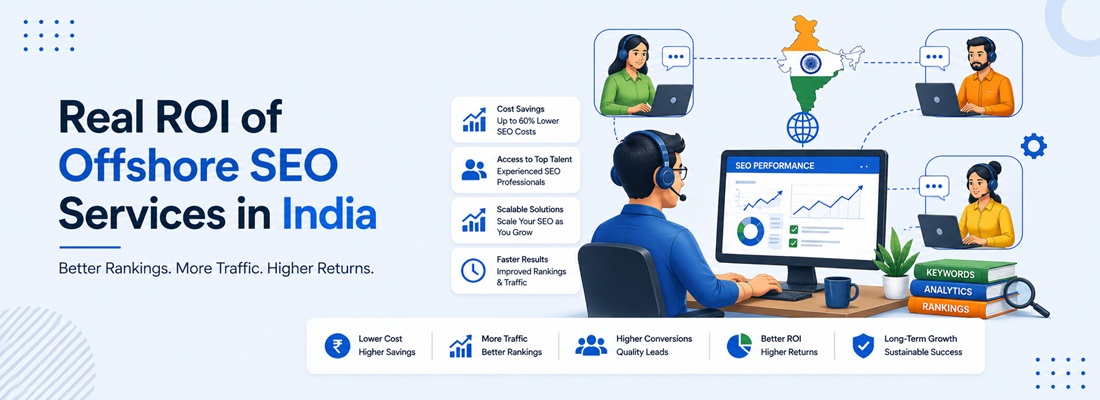
Many business owners wonder if hiring an outside team for search engine work is worth the cost. They see the monthly bills and question the benefits. This guide breaks down the real numbers behind offshore SEO partnerships. It explains what ROI is, how to measure it, and the factors that drive success. Knowing the offshore SEO ROI in India helps a company decide if this move makes financial sense.
The choice to send SEO work overseas involves more than comparing monthly fees. A smart business looks at value, not just cost. Simple formulas can reveal whether an offshore partnership brings positive results. By the end, any business owner can evaluate their SEO spending with confidence.
Want More Traffic and Better Rankings?
Reach more customers, improve search visibility, & build a strong online presence with a clear SEO strategy.

What Does ROI Mean in SEO Outsourcing?
Return on investment compares what a business spends against what it gains. In SEO terms, spending includes agency fees, tools, and internal management time. Gains include organic traffic value, lead generation, and direct sales from search visitors. A positive ROI means the gains outweigh the costs.
Figuring out SEO returns proves trickier than other marketing channels. Paid ads show clear cost-per-click numbers right away. SEO builds value slowly over many months. A campaign might lose money in the first three months but deliver big returns in year two. Smart businesses measure ROI across twelve-month periods.
Here are the components that feed into SEO ROI calculations:
- Organic traffic value. Multiply monthly search visitors by what it would cost to get those clicks through paid ads. This represents direct advertising savings.
- Lead and sales attribution. Track how many form fills, calls, or purchases come from organic search. Assign a dollar value to each converted visitor based on customer lifetime value.
- Brand visibility lift. Ranking higher for branded terms builds trust. This intangible benefit reduces future marketing costs across all channels.
- Time savings from delegation. Calculate the hours internal staff no longer spend on SEO tasks. Multiply those hours by their hourly wage to find hidden savings.
- Compound growth effect. Rankings achieved this month continue paying dividends next year. Unlike paid ads, SEO value accumulates without repeated spending.
Cost vs Value: Understanding Offshore SEO Pricing
Many businesses focus only on the monthly fee when comparing SEO providers. This limited perspective overlooks the broader context. A lower price might deliver zero results, wasting every dollar spent. A higher fee that produces consistent traffic gains offers real value.
The difference between cost and value becomes clear when looking at outcomes. Cost represents what leaves the bank account. Value represents what comes back in leads, sales, and brand authority. An expensive campaign that doubles organic revenue provides excellent value. A low-cost campaign has no value if it doesn’t move any rankings.
Here is a simple breakdown of how to think about SEO pricing:
| Pricing Model | What You Pay For | What You Get |
|---|---|---|
| Low-cost monthly retainer | Basic reporting, minimal link building, generic content | Slow or no ranking movement, wasted budget |
| Mid-range performance package | Targeted keyword research, regular content, quality backlinks | Steady traffic growth, improving lead volume |
| Strategic partnership model | Deep industry analysis, custom content strategy, authority building | Compound returns, lasting market position |
Choosing to outsource SEO to India shifts this value calculation further. Lower operating costs in India mean a business gets more work for the same budget. More content, more links, and more technical audits happen without raising the monthly fee. This amplifies the potential ROI significantly.
Key Factors That Influence SEO Outsourcing ROI
The financial outcomes from offshore partnerships display different patterns because their operating results produce varying financial outcomes. Organizations must track various elements which decide if their marketing initiatives will achieve success or result in failure. Business organizations need to understand these elements because they will select their suitable partners and build achievable targets.
The offshore team’s quality stands as the primary factor, which exceeds all location-based considerations. A team of skilled professionals who follow established procedures produces regular outcomes. An inexperienced team wastes time on outdated tactics that search engines punish.
Here are the critical factors that shape SEO outsourcing returns:
- Industry experience of the offshore team. A team familiar with a specific niche moves faster. They already know which keywords convert and which content formats attract links.
- Communication structure and reporting frequency. Weekly video calls and shared dashboards prevent misunderstandings. Clear reporting ties every activity to measurable outcomes.
- Contract flexibility and trial periods. Short-term commitments allow testing before long-term investment. A three-month trial reveals whether the partnership fits.
- Access to client data and systems. The offshore team needs analytics, search console, and CRM access. Denying this access cripples their ability to measure and adjust.
- Quality of content production. Thin, generic content wastes everyone’s time. Well-researched, useful content attracts links and engages visitors naturally.
- Link-building approach and safety. White-hat methods build lasting authority. Black-hat shortcuts invite search engine penalties that destroy ROI.
SEO outsourcing in India offers particular advantages in several of these areas. Indian professionals often hold advanced degrees and speak fluent English. Many have worked with USA clients for years, understanding Western business expectations. This experience makes communication smoother than with less-established offshore markets.
How to Calculate the ROI of Outsourcing SEO to India
Putting numbers on SEO returns requires a straightforward formula. First, add up all costs associated with the offshore partnership. Include monthly fees, tool subscriptions, and internal staff time managing the relationship. This total represents the investment.
Second, calculate the revenue generated from organic search during the same period. Track form submissions, phone calls, and e-commerce purchases from non-paid search traffic. Multiply each conversion by the average customer lifetime value. This total represents the return.
Here are the steps to calculate the ROI of outsourcing SEO to India:
- The first step requires you to include all SEO expenses that occurred during the specified time. To get the total investment number, you need to combine agency fees with software expenses and convert internal labour hours into their corresponding dollar values. The total investment number becomes available through this calculation.
- The second step requires you to determine the revenue generated by organic search results. The process of tracking organic traffic sales requires analytics data together with CRM data to conduct this analysis. The system calculates future lead value by using past conversion data to determine how many leads will turn into sales.
- The third step requires you to apply the ROI formula to your data. Subtract investment from return, then divide by investment, then multiply by 100. A positive percentage means the campaign makes money. ROI = (Return – Investment)/Investment * 100
- The process requires a twelve-month period of tracking data. SEO development occurs at a slow pace, which makes monthly ROI numbers untrustworthy. A twelve-month window shows the true picture.
A sample calculation makes the situation clearer. Suppose a business spends $5,000 monthly on an offshore SEO team. Over six months, the total investment equals $30,000. During that period, organic search drives $60,000 in direct sales. The ROI equals 100%. The business doubled its money.
Short-Term vs Long-Term SEO Returns
SEO does not deliver instant gratification. The first few months of any campaign often show minimal revenue movement. This does not mean the strategy fails. This indicates that the investment is still progressing towards a critical juncture.
Short-term returns are derived from easily accessible opportunities. Fixing technical errors, updating old content, and targeting less competitive keywords produce quick wins. These gains build confidence and fund further investment. Long-term returns require patience. Authority building, competitive link acquisition, and category dominance take twelve to eighteen months.
Here is a comparison of what to expect at different stages:
| Time Period | What to Expect | ROI Direction |
|---|---|---|
| Months 1 to 3 | Technical fixes, content updates, and initial link building | Negative or break-even |
| Months 4 to 6 | First ranking movements, traffic uptick, some leads | Approaching positive |
| Months 7 to 12 | Steady traffic growth, consistent leads, and brand visibility | Clearly positive |
| Months 13 to 24 | Market dominance, reduced ad spend reliance, and strong authority | Highly positive |
Choosing offshore SEO services in India does not change this timeline, but it changes the slope. More work gets done for the same budget, which accelerates progress. A campaign that might take eighteen months with a local agency could show strong returns in twelve months with an offshore partner.
How to Maximize ROI with SEO Outsourcing in India
The business owner must actively engage in their operations to achieve the highest possible return on investment. The success of an offshore team depends on their ability to receive information while maintaining access to operations and building trust with their counterparts. Clients who achieve the highest ROI through their actions demonstrate multiple standard behaviours, which they practice regularly.
The process of keyword research becomes more efficient when businesses offer detailed customer information. The team base their sales data-sharing process on their ability to start working with the most valuable sales data points. The production process continues to move forward because the team responds quickly to content requests. Small actions create a total effect, which helps the website achieve higher search engine rankings at a faster rate.
Here are the proven ways to boost SEO outsourcing return on investment:
- Share internal sales and customer service data. Let the SEO team know which products sell best and what questions customers ask. This guides content creation toward topics that actually convert.
- Approve content drafts within two business days. Delays in the approval process stall momentum. Fast turnarounds keep the publishing calendar on track.
- Set up proper tracking before the campaign starts. Install goal tracking in analytics and connect CRM data to search traffic. Measuring results accurately from day one prevents guesswork.
- Integrate SEO with other marketing channels. A ranking blog post can feed social media content. Email newsletters can promote newly ranking pages. Paid ads can retarget organic visitors.
- Conduct quarterly ROI reviews. Regular check-ins catch problems early before they waste months of budget. Adjust strategy based on what the numbers show.
One often overlooked factor involves integrating SEO with other marketing channels. A blog post that ranks well can feed social media content. Email newsletters can promote newly ranking pages. Paid ads can retarget organic visitors. This cross-channel approach multiplies the value of every SEO dollar spent.
Businesses serious about maximizing returns should also calculate SEO outsourcing ROI at regular intervals. A quarterly review keeps the campaign aligned with business goals. It also catches any problems early, before they waste months of budget.
Final Thoughts
The real ROI of offshore SEO depends on choosing the right SEO partner and measuring correctly. A campaign that costs less but delivers nothing offers no value. A campaign that costs more but doubles organic revenue provides excellent returns. Every time, the math favours quality over low prices.
Businesses that commit to a twelve-month horizon see the best results. They weather the early months of investment without panicking. By month nine, the traffic gains start paying back the initial outlay. The returns frequently surpass expectations by the eighteenth month.
Offshore SEO ROI in India looks strong for companies that follow the principles outlined here. Pick a skilled team, share data freely, and measure returns properly. Avoid the trap of focusing only on monthly fees. Value, not cost, determines whether an SEO partnership succeeds or fails.
FREQUENTLY ASKED QUESTIONS
Most businesses see break-even results around month six. Positive ROI usually shows up between months seven and twelve. Faster results happen when going after less competitive keywords first.
Anything above 100% counts as strong performance. Top campaigns give 300 to 500% ROI over twelve months. Compare these results to other marketing channels for background.
Six-month minimum deals usually work best. SEO takes time to build speed. Shorter contracts make it challenging to reach the turning point where returns turn positive.
Yes, give dollar values to leads based on average sale size. Track how many calls or form fills come from an organic search. Multiply leads by conversion rate and average order value.
Rushing and poor tracking cause most failures. Switching providers every few months resets all progress. Not measuring results makes it impossible to know what works.